


The Real Problem with Finding Apartments No Breed Restrictions
Apartments no breed restrictions are harder to find than they should be — but they do exist, and knowing where to look makes all the difference.
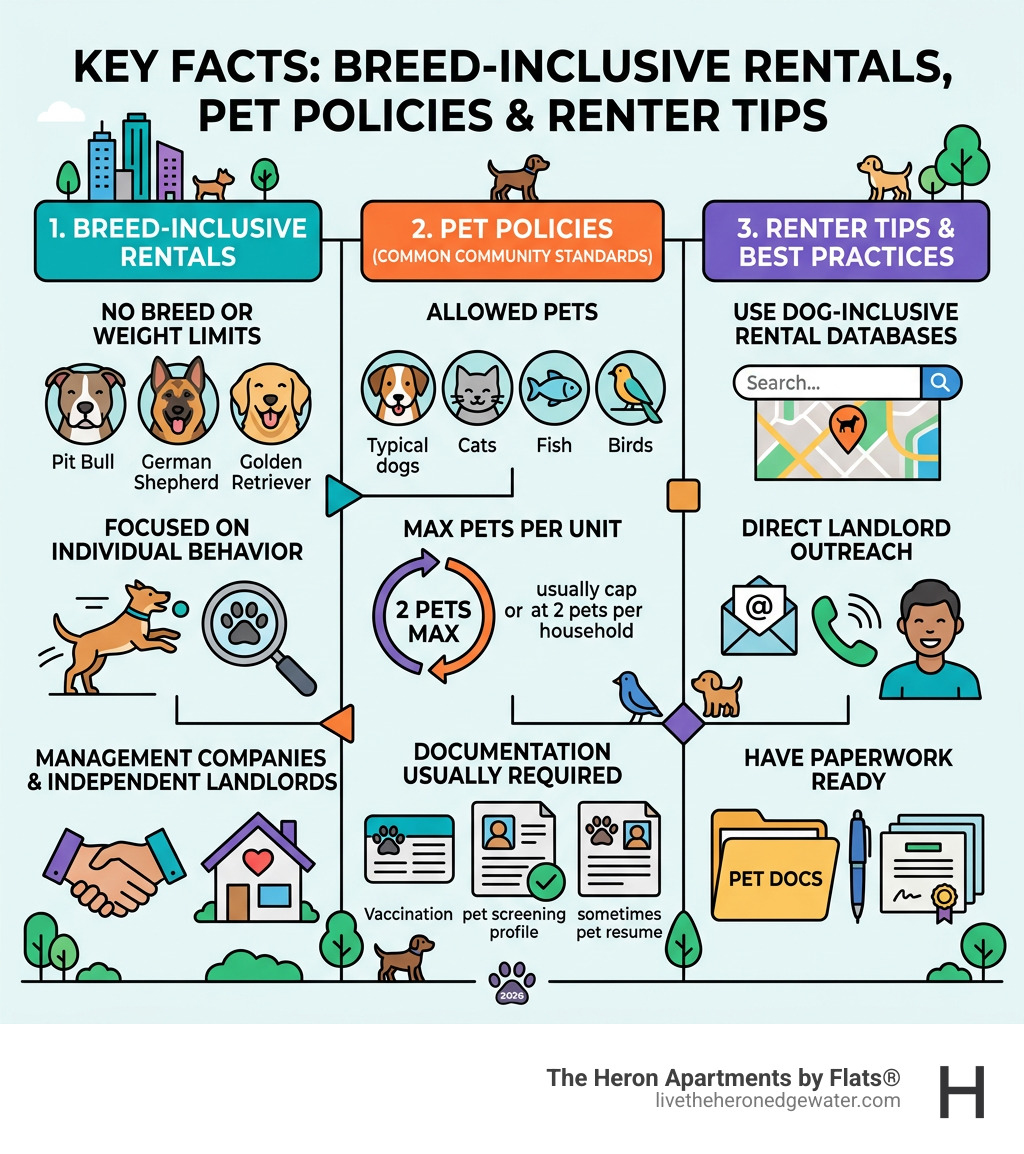
Here's a quick snapshot of what to know before you dive in:
| What You're Looking For | What to Know |
|---|---|
| No breed or weight restrictions | Some management companies and independent landlords offer fully open pet policies |
| Allowed pets | Typically domestic dogs, cats, fish, and birds |
| Max pets per unit | Most communities cap at two pets per household |
| Documentation usually required | Vaccination records, pet screening profile, sometimes a pet resume |
| Legal protections | Fair Housing Act covers service animals; Emotional Support Animals have separate protections |
| Best places to search | National dog-inclusive rental databases, direct landlord outreach |
Finding a place to live with your dog shouldn't feel like a second job. But for millions of renters, it does.
You find the perfect apartment. Natural light, great location, rooftop views. Then you hit the pet policy page — and see your dog's breed on the restricted list.
It's a frustrating reality. Many rental communities limit which dogs are welcome based on breed alone, even though a 2022 study published in Science found that breed accounts for less than 9% of the variation in individual dog behavior.
The good news? Not every community draws that line. Some apartments welcome all breeds, focus on the individual dog, and still maintain clear, fair pet policies. This guide will help you find them — and give you the tools to land a home where your pet is truly welcome.
Understanding Breed Restrictions in the Rental Market
When we talk about breed restrictions, we are referring to policies that prevent certain types of dogs from living in a rental community. These lists often target breeds like Pit Bull Terriers, Rottweilers, Doberman Pinschers, and Chows. But why do these lists exist in the first place?
In many cases, it isn't actually the property manager who dislikes a specific breed. Often, these restrictions are driven by insurance policies. Many commercial insurance providers have "prohibited breed" lists. If a landlord allows one of these breeds, their insurance coverage could be affected or canceled entirely. This leads many management companies to implement blanket bans as a form of risk management.
However, many animal advocacy groups have challenged this logic. They argue that a dog’s behavior is shaped far more by its environment and the way it is raised than by its DNA. When searching for apartments for rent that allow dogs, it is helpful to understand that these decisions are often based on outdated stereotypes rather than the individual dog standing in front of the landlord.
Common Myths vs. Reality for Apartments No Breed Restrictions
There is a lot of misinformation out there regarding "aggressive" breeds. To find apartments no breed restrictions, it helps to be armed with the facts.
- Myth: Certain breeds are naturally more aggressive toward people.
- Reality: According to the ATTS breed statistics, American Pit Bull Terriers scored an 87.6% on temperament tests. To put that in perspective, that is a higher passing rate than Golden Retrievers (85.9%) and Beagles (80.5%).
- Myth: Breed determines how a dog will act in an apartment.
- Reality: As mentioned in the Science study, breed accounts for less than 9% of behavioral variation. Training, socialization, and owner care are the real predictors of whether a dog will be a "good neighbor."
- Myth: Large dogs are more dangerous or destructive in small spaces.
- Reality: Many large breeds, like Greyhounds or Great Danes, are famously known as "couch potatoes" who thrive in apartment settings, while some small, high-energy terriers may be more prone to barking or chewing.
By focusing on individual temperament rather than a label, progressive communities are opening their doors to a wider variety of four-legged residents.
Navigating Your Search for Apartments No Breed Restrictions
Searching for a home when you have a "restricted" breed requires a bit more strategy than a standard apartment hunt. While major listing sites are a start, they don't always have the most up-to-date info on specific breed nuances.

One of the best ways to find a welcoming home is to use a specialized Housing Database. These resources are often crowdsourced by pet advocates who verify which properties have truly inclusive policies.
In cities like Chicago, we see a mix of management styles. Large management companies often have standardized rules, but some national companies have moved toward "no breed or weight restriction" policies to attract responsible pet owners. On the other hand, independent landlords can be more flexible. Because they own the property directly, they may be willing to meet your dog and make a decision based on a "pet interview" rather than a list of rules.
If you are looking for dog-friendly rentals near me, always call the leasing office directly. Policies change frequently, and sometimes a "no" on a website is actually a "maybe" if you can provide the right documentation.
Essential Documentation for Apartments No Breed Restrictions
If you find a community that is on the fence, or if you want to stand out as a top-tier applicant, coming prepared with a "pet portfolio" is a game-changer. Think of it like a job application for your dog.
When looking at pet-friendly apartments for rent, having these items ready can smooth the approval process:
- Vaccination Records: Proof that your pet is up to date on rabies and other required shots is a non-negotiable for almost every landlord.
- A Pet Resume: Include a photo, your dog’s weight, their favorite activities, and a short "bio" describing their personality.
- Canine Good Citizen (CGC) Certification: The Canine Good Citizen certification from the AKC is a gold standard. It proves your dog has mastered 10 basic skills, including walking through a crowd and sitting politely for pets.
- Reference Letters: A quick note from a previous landlord, a neighbor, or even your veterinarian can go a long way in proving your dog is a quiet, well-behaved resident.
- DNA Test Results: If you have a mixed breed that "looks" like a restricted breed but isn't, a DNA test can sometimes clear up confusion during the screening process.
Legal Protections and Pet Classifications
It is important to understand the legal distinctions between different types of animals in a rental setting. Under the Fair Housing Act (FHA), there are specific protections that might apply to your situation.
- Service Animals: These are dogs specifically trained to perform tasks for people with disabilities. Under the FHA, they are not considered "pets" and are generally exempt from breed restrictions and weight limits.
- Emotional Support Animals (ESA): An ESA provides companionship and helps alleviate symptoms of a mental or emotional disability. While they do not require specialized training like service animals, they do require a letter from a licensed healthcare professional. In many cases, ESAs are also protected under the FHA, allowing them to bypass breed bans and standard pet policies.
- Regular Pets: These are companion animals that do not have a specific medical or service designation. They are subject to the property's standard pet policies.
Some regions are also seeing legislative changes. For example, the "Pets in Housing Act" and similar local movements aim to limit the ability of landlords to discriminate based on breed or size. If you are looking for an apartments large dogs guide, keep an eye on local Chicago ordinances, as the city is known for being particularly dog-friendly compared to other major metros.
Frequently Asked Questions about Breed-Inclusive Housing
We know that moving with a pet brings up a lot of questions. Here is a breakdown of what you can typically expect when looking for a breed-inclusive community.
| Feature | Standard Pet Policy | Breed-Inclusive Policy |
|---|---|---|
| Breed List | Restricted (Pit Bulls, Rottweilers, etc.) | All domestic breeds welcome |
| Weight Limit | Often 25–50 lbs | No weight limit or high limits (70+ lbs) |
| Screening | Visual check or vet records | Often uses third-party screening tools |
How many pets are permitted per household?
In almost all professional managed communities, the standard limit is two pets per household. This usually applies to any combination of domesticated animals, such as two dogs, two cats, or one of each. While fish and small caged birds are often permitted, they may still count toward the total "pet count" or have specific tank size requirements.
What amenities are common in pet-friendly communities?
A truly pet-friendly apartment goes beyond just "allowing" dogs; it makes life easier for the owners, too. When touring, look for:
- On-site Bark Parks: Fenced-in areas where dogs can run off-leash safely.
- Pet Spa or Dog Wash: An apartments with dog wash station is a lifesaver in Chicago winters, keeping the salt and slush out of your living room.
- Grooming Stations: Dedicated spaces for brushing and basic maintenance.
- Proximity to Parks: Being near local green spaces or lakefront trails is a huge bonus for active breeds.
What documentation is required for pet approval?
Most modern apartments use a digital screening process. You will likely need to create a pet profile that includes your dog's age, breed, and health history. Expect to provide:
- Current vaccination records.
- Proof of parasite prevention.
- Annual renewals of your pet's profile to ensure all records stay current.
Conclusion
Finding apartments no breed restrictions doesn't have to be an impossible task. By understanding why these restrictions exist, preparing a solid pet resume, and targeting communities that value individual behavior over labels, you can find a home that welcomes every member of your family.
At The Heron Apartments by Flats®, we pride ourselves on being a premier destination for pet lovers in Edgewater, Chicago. Our community is designed with both style and function in mind, featuring luxury amenities that cater to your lifestyle. From our modern, adaptable units to our pet-friendly facilities, we provide a space where you and your pets can truly feel at home.
Ready to stop searching and start living? Explore our community and find your next home with us today.