

Your Home, Intelligently Designed
Smart space technology transforms your living environment into a responsive ecosystem that adapts to your needs. Here's what you need to know:
What Smart Space Technology Offers:
- Networked sensors and IoT devices that monitor temperature, occupancy, air quality, and lighting
- Automated systems that adjust your environment based on real-time data and your preferences
- Remote control via smartphone apps and voice assistants for seamless management
- Energy efficiency through intelligent heating, cooling, and lighting optimization
- Improved security with smart locks, cameras, and access control systems
Imagine showing up at your apartment and not having the physical space or tools to create the exact environment you need. For many, this frustration is real. You want your lights to adjust automatically when you walk in. You want your thermostat to learn your schedule. You want your space to work with you, not against you.
Smart spaces go far beyond a programmable thermostat. They're connected places equipped with networked sensors, IoT devices, and intelligent infrastructure that collect and analyze data about your environment. These systems use that information to improve functionality and efficiency, making everyday tasks easier while reducing energy waste.
According to research, 34% of people cited slow technology as a major dealbreaker, and more than 53% of companies plan to increase their investment in user experience technology. The message is clear: people expect their living spaces to be as intelligent and responsive as the devices they carry in their pockets.
At The Heron Apartments, smart space technology isn't just about gadgets. It's about creating a user experience that feels effortless—where your home anticipates your needs, responds to your preferences, and gives you complete control from anywhere.
What is a Smart Space? From Concept to Reality
At its core, a smart space is an environment or facility that uses data and technology to automate systems, improve visibility, increase efficiency, and make everyday tasks easier. The term "smart" itself can be traced back to an acronym for “self-monitoring, analysis, and reporting technology” according to NetLingo. This perfectly encapsulates the essence of smart space technology: environments that can sense, understand, and react to their surroundings and occupants.
These connected places are physical locations equipped with networked sensors and intelligent infrastructure. They collect and analyze indoor location data and other environmental metrics, improving the functionality and efficiency of the space. Imagine your apartment in Edgewater, Chicago, not just as four walls and a roof, but as a responsive ecosystem. This technology allows the space to become more responsive to the needs of its residents, from adjusting lighting based on natural light levels to optimizing heating and cooling based on occupancy. The overarching goal is automation and optimization, creating a seamless and intelligent experience.
The Goal: A Seamless User Experience
The ultimate aim of smart space technology is to provide a seamless user experience. This means creating personalized environments that adapt to your preferences without constant manual intervention. Think about your ideal living space: comfortable, intuitive, and always just right. Smart spaces achieve this through automated adjustments to lighting, temperature, and other environmental factors. This focus on convenience and comfort significantly reduces manual tasks, freeing up your time and mental energy.
It's about empowering you with control over your living environment. Just as businesses are looking to give employees control over their working life, including environmental and access controls, we believe residents deserve the same level of empowerment in their homes. While 90% of executives implement technology based on what’s best for their people, only 53% of employees say the same, highlighting a gap between intention and real-world experience. Our approach ensures that the technology truly serves you, enhancing your daily life rather than complicating it.
From Smart Buildings to Smart Apartments
While the concept of smart spaces often conjures images of vast commercial complexes or smart cities, its evolution has profoundly impacted residential living. Smart buildings, in general, are transformative, allowing structures to become living organisms that can sense the world, make decisions, and interact with devices and humans. This change is now filtering down to individual apartments, creating smart homes within smart buildings.
For residents in Edgewater, Chicago, this means a significant upgrade to their living experience. Our apartments, which already boast modern amenities, integrate these intelligent systems. These include networked temperature and motion sensors that contribute to individual climate control, allowing for precise and personalized environmental management. It's about having integrated systems that work together to create a cohesive and responsive home, aligning with the vision of apartments with modern amenities.
The Core Components of Smart Space Technology
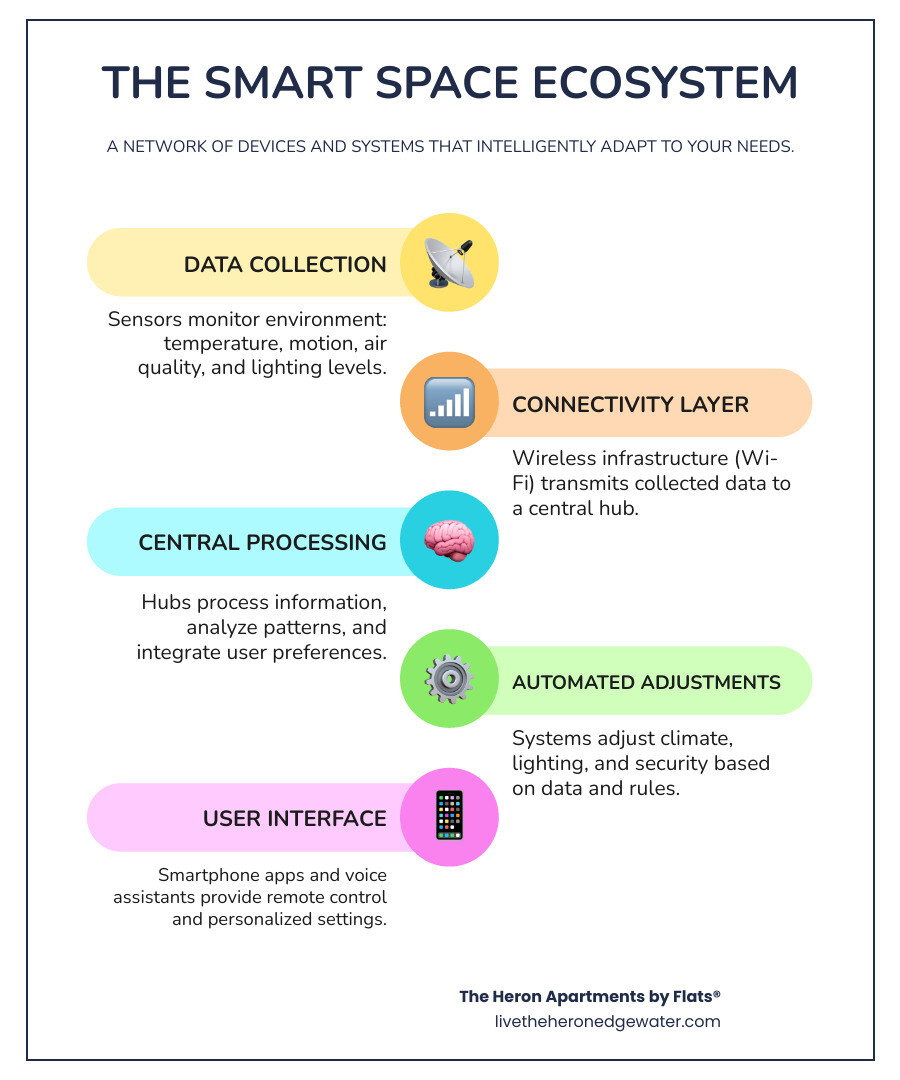
The magic of smart space technology isn't just one device; it's a symphony of interconnected components working in harmony. These elements gather data, communicate, and execute actions to create a truly intelligent environment.

The Internet of Things (IoT) and Sensors
At the heart of any smart space are the Internet of Things (IoT) devices and an array of sophisticated sensors. IoT devices are everyday objects embedded with electronics, software, sensors, actuators, and network connectivity that allow them to collect and exchange data. These devices form the nervous system of your smart home.
Consider the role of sensors:
- Motion sensors detect presence, triggering lights or adjusting HVAC settings.
- Temperature sensors continuously monitor ambient conditions, informing your smart thermostat.
- Air quality monitors detect pollutants, allergens, or CO2 levels, prompting ventilation.
- Smart cameras, similar to those used for security and surveillance in larger facilities, provide visual monitoring and can be integrated for various purposes.
Sensors play a crucial role in capturing data related to occupancy, temperature, air quality, and other environmental factors. This constant stream of data is what makes a space truly "smart," allowing for informed decisions and automated responses. IoT devices like smart thermostats and lighting systems then translate this data into actionable changes, enabling remote control and automation of various home functions.
Connectivity and Central Hubs
What makes these diverse devices "smart" is their ability to communicate. This is where robust connectivity and central hubs come into play. Wireless infrastructure, particularly high-speed Wi-Fi, is the backbone, allowing all IoT devices and sensors to transmit their data and receive commands seamlessly. Ubiquitous connectivity is the foundational element for all smart space technology.
Centralized control typically comes in the form of smartphone apps or voice assistants. These act as the brain of your smart home, providing a single interface to manage all your connected devices. Whether you're adjusting your lights, checking your security feed, or controlling your smart locks, it all happens through these hubs. For instance, the convenience of apartments with smart locks means you can manage access to your home directly from your phone, no matter where you are. Wireless communications empower this collaboration between devices and accelerate the adoption of user-friendly applications.
The Role of Data in Optimizing Smart Space Technology
Data is the lifeblood of smart space technology. Without it, smart spaces would just be automated spaces. Advanced analytics and machine learning algorithms process the vast amounts of data collected by sensors and IoT devices. This data allows the system to recognize patterns, predict your preferences, and make predictive adjustments.
For example, by analyzing occupancy data and your historical climate control settings, your smart thermostat can learn your schedule and preferences, pre-heating or cooling your apartment before you arrive. This provides us with more and better information about the condition and usage of physical locations. Data analytics helps in understanding user behaviors, detecting patterns, and optimizing the environment for comfort and efficiency. This constant feedback loop of data collection, analysis, and action is what truly optimizes smart spaces, making them safer, more seamless, and genuinely intelligent.
Key Benefits: Enhancing Daily Life, Safety, and Sustainability
Smart space technology isn't just about cool gadgets; it's about tangible benefits that improve your daily life in significant ways. From the moment you wake up to when you drift off to sleep, these intelligent systems work tirelessly to improve your comfort, safety, and even contribute to a healthier planet.

Improved Comfort and Convenience
Imagine stepping into your Edgewater apartment, and the lights gently brighten to your preferred level, the temperature is perfectly set, and your favorite music begins to play – all without lifting a finger. This is the promise of improved comfort and convenience delivered by smart space technology.
Personalized lighting, automated temperature control, and remote access to your home's systems are just the beginning. Smart spaces provide personalized and comfortable experiences, adapting to your routine and preferences. Automated lights and climate control reduce friction in your day, allowing you to focus on what matters. Whether you're adjusting your thermostat from your office or turning off lights you forgot while already out the door, remote access offers unparalleled convenience and peace of mind. This improved occupant experience, driven by convenience, is a cornerstone of modern living.
Environmental Sustainability and Efficiency
Beyond personal comfort, smart space technology plays a crucial role in environmental sustainability and efficiency, which translates into responsible living. Smart buildings can achieve a 45-percent improvement in energy efficiency through the use of DC power, and smart spaces can reduce energy consumption through real-time adjustments of heating, cooling, and lighting.
Our intelligent systems optimize energy consumption by automatically adjusting lighting, heating, and cooling based on occupancy and environmental conditions. This means less wasted energy when you're away and peak efficiency when you're home. Automating lighting and heating not only minimizes energy usage but also helps reduce your carbon footprint, aligning with global efforts toward sustainability. This proactive resource management ensures that your apartment is as environmentally conscious as it is comfortable.
Here are some energy-saving smart devices that contribute to a greener lifestyle:
- Smart thermostats that learn your schedule and optimize heating/cooling.
- Occupancy sensors that turn off lights and adjust climate when a room is empty.
- Smart lighting systems that dim or turn off based on natural light availability.
- Smart power strips that cut power to idle electronics.
- Automated blinds or shades that regulate sunlight to control indoor temperature.
Improved Safety and Security
Your home should be your sanctuary, and smart space technology significantly improves safety and security, providing invaluable peace of mind. These systems offer real-time monitoring and proactive hazard detection.
Smart locks, for instance, allow you to control and monitor access to your apartment remotely, eliminating the worry of lost keys. Integrated sensors can detect environmental conditions like temperature, humidity, or even water leaks, providing early warnings to prevent potential damage. Similar to how surveillance systems are used to improve safety in commercial settings, our smart systems can provide a sense of security while being functional. This includes smart cameras and other sensors. In the event of an emergency, these systems can even facilitate a more efficient emergency response by providing critical information. The ability to monitor your home and prevent unauthorized access to restricted areas means you can rest assured that your personal space is well-protected.
Smart Spaces in Action: Changing Modern Living
The integration of smart space technology is redefining what it means to live in a modern apartment. It's about creating dynamic, responsive environments that adapt to your lifestyle, exemplified by the innovative features we offer at The Heron Apartments in Edgewater, Chicago.
Real-World Examples of Smart Space Technology in Apartments
The applications of smart space technology in apartments are diverse and continually evolving. You might already be familiar with some of these:
- Smart thermostats that learn your preferences and adjust the climate for optimal comfort and energy savings.
- Automated blinds that can open and close based on the time of day, sunlight intensity, or your personal schedule, helping to regulate temperature and privacy.
- Smart lighting systems that can be controlled remotely, dimmed, or set to specific scenes to match your mood or activity.
- Voice-controlled entertainment systems that respond to your commands, allowing you to manage music, movies, and more hands-free.
These examples, often found in a studio apartment transformation, showcase how technology works seamlessly to improve daily living, creating a truly intelligent home experience.
Maximizing Your Floorplan with Transformable Furniture
One of the most exciting advancements in smart space technology for urban living, especially in dynamic cities like Chicago, is the integration of robotic, transformable furniture. This innovation is a unique selling point of our adaptable Ori Apartments at The Heron.
These ingenious solutions, like the Ori Cloud Bed, Ori Pocket Closet, and Ori Pocket Office, allow you to maximize every square foot of your apartment. With the touch of a button or a voice command, your living room can become a bedroom, or your workspace can disappear, revealing more open space. This intelligent use of space ensures that your apartment is always optimized for your current needs, offering unparalleled flexibility. As we've seen in office environments, smart solutions help you get the most out of the space you do have, and the same principle applies brilliantly to residential living. To learn more about how these units can revolutionize your living experience, explore how to transform your apartment.
Challenges and Future Outlook
While smart space technology offers incredible benefits, its implementation comes with considerations. Data privacy and cybersecurity are paramount concerns. As more devices connect and collect data about our routines, ensuring that this information is secure and used responsibly is crucial. Reputable providers prioritize cybersecurity measures, ensuring processes and tools are compliant with strict standards.
Another challenge is "tool fatigue." In our personal lives, we use an average of 30 different apps each month. The proliferation of smart devices can sometimes lead to a fragmented experience if not properly integrated. The future of smart space technology lies in greater integration and seamless interoperability, ideally managed through a single, intuitive platform.
The future outlook is incredibly promising. We anticipate an even deeper integration of artificial intelligence (AI) into our homes, moving beyond simple automation to truly predictive and personalized environments. AI will enable systems to anticipate needs even more accurately, proactively adjusting settings for optimal comfort, health, and energy efficiency. Imagine your home not just reacting to you, but learning and adapting over time to become an extension of your preferences. This continuous evolution will lead to even more intuitive and effortless living experiences, making intelligent homes the standard rather than the exception.
Here's a glimpse into the evolution of smart home features:
| Current Smart Home Features | Future Possibilities in Smart Spaces |
|---|---|
| Smart Thermostats | Predictive climate control based on personal health data and weather forecasts |
| Remote Lighting Control | Dynamic lighting that mimics natural light cycles for improved well-being |
| Smart Locks | Biometric access and temporary guest access management |
| Voice Assistants (basic) | Proactive AI companions that anticipate needs and manage complex routines |
| Security Cameras | AI-powered anomaly detection and personalized security alerts |
| Automated Blinds | Energy-optimizing window treatments that respond to external light and temperature |
| Appliance Monitoring | Predictive maintenance and automated ordering of consumables |
Conclusion: The Future of Intelligent Living
Smart space technology is more than a trend; it's the foundation of modern living, changing our apartments into responsive, intuitive, and highly efficient environments. We've explored how these intelligent systems, built on networked sensors, IoT devices, and data analytics, deliver tangible benefits: unparalleled comfort and convenience, significant environmental sustainability and efficiency, and robust safety and security.
At The Heron Apartments in Edgewater, Chicago, we are committed to providing residents with a living experience that anticipates their needs and improves their daily lives. From individual climate control to the innovative space-maximizing Ori units, we believe that smart living should be a standard, not a luxury. Our focus is on creating homes where technology works seamlessly in the background, making life simpler, safer, and more enjoyable.
As smart space technology continues to evolve, we are excited to remain at the forefront, integrating advancements that further lift the resident experience. We invite you to find how intelligent design and cutting-edge technology converge to create an exceptional living environment. To learn more about how these modern amenities redefine apartment living, we encourage you to explore our modern apartment amenities.